Quick Answer: Hot Runner Controller TroubleshootingThe most common hot runner controller alarms are ...
Stop the Downtime: How to Fix Common Hot Runner Controller Alarms (ERR, TC Break, Short)
2026-03-06

Quick Answer: Hot Runner Controller Troubleshooting
The most common hot runner controller alarms are TC Break, Short Circuit, and Temperature Deviation (ERR).
Typical troubleshooting steps include:
Check thermocouple wiring
Inspect heater resistance
Verify power supply voltage
Examine connector pins
Run PID auto-tuning
These steps resolve most hot runner temperature controller issues in injection molding systems.
In a high-pressure injection molding environment, a "Down" machine is a major profit killer. We’ve all been there: your hot runner temperature control systems start flashing red, the alarm buzzes, and production stops. Most of the time, these issues are fixable on-site if you know what to look for.
This guide breaks down the "Big Three" alarms that plague hot runner controllers and gives you a clear path to get back to molding parts.
Common Hot Runner Controller Alarms
If your hot runner temperature controller is acting up, don't panic. Follow these steps to diagnose the root cause.
Issue 1: The "TC Break" or "Open" Error
This is the most frequent headache. It means the feedback loop between the mold and the hot runner temperature control systems is broken.
The Symptom
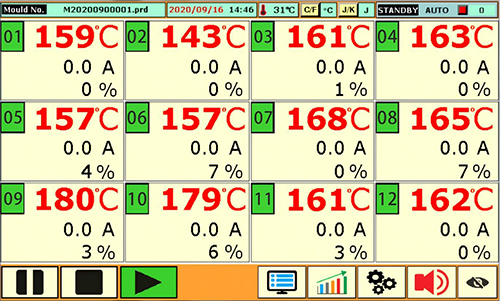
The zone display shows "OPEN," "TC ERR," or "---". The controller stops sending power to that specific zone to prevent a runaway heater.
The Cause
Usually, it’s a physical break: a snapped thermocouple wire inside the mold or a loose pin in your heavy-duty connector (HDC).
The Fix
First, swap the "broken" module with a known working one. If the error stays on the same zone, the problem is in your mold. Check your thermocouple polarity (+/-). Our systems support both J and K type thermocouples with dynamic tracking compensation.
Issue 2: Short Circuit & Over current
Shorts are dangerous because they can fry your electronics or damage the mold manifold.
The Symptom
The circuit breaker trips immediately, or the hot runner controllers flash "SHORT" and cut power.
The Cause
The #1 culprit is plastic leakage encasing the heater wires. Another cause is moisture build-up inside the heater elements (common after long shutdowns).
The Fix
Stop immediately and "ohm-out" the heater. TOPOWER controllers are rated for a Single Zone Output Current of 15A MAX (240VAC). If the issue is moisture, use our Soft Start feature to bake out moisture at low voltage before ramping to full power.
Issue 3: Temperature Deviation (ERR / High-Low)
The Symptom
The temperature deviates from the set point, leading to silver streaks or burned spots on molded parts.
The Cause
Usually, a PID tuning issue. With a Sampling Frequency of 10HZ (100ms), our controllers are sensitive to even minor fluctuations.
The Fix
Run an Auto-Tuning cycle. Our PID / PIDD Digital Control mode will automatically recalibrate the parameters to match your mold’s thermal mass, maintaining a Repeat Temp Control Precision of +/-0.1%.

What Causes Hot Runner Controller Alarms?
Several factors can trigger alarms in a hot runner temperature control system.
1. Thermocouple Failure
Thermocouples operate in high-temperature environments and may degrade over time.
2. Heater Damage
Repeated heating cycles can cause insulation breakdown.
3. Wiring Problems
Poor electrical connections are one of the most common issues in industrial temperature control systems.
4. Moisture or Contamination
Moisture entering heater elements may cause short circuits.
5. Incorrect Controller Settings
Improper PID parameters can result in unstable temperature control.
Routine maintenance and inspection significantly reduce these risks.
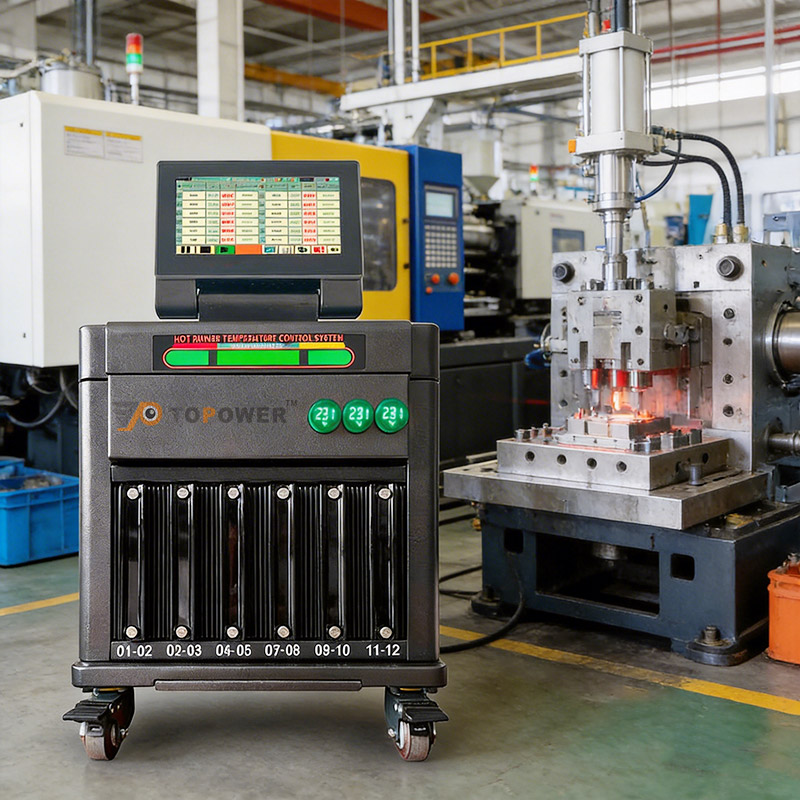
The TOPOWER Solution: HY20 Intelligent Touch Screen Series
Dealing with errors is part of the job, but your hardware shouldn't make it harder. Our HY20 Series is designed for high-performance molding, offering a robust Single Zone Output Power of 3600W Max (240VAC).
Technical Comparison: HY20 Hot Runner Controllers
All HY20 models feature Auto/Manual/Standby work modes and a wide Temp Control Range (45-450°C).
Model & Link | Max Zones | Total Power | Power Input | Connectors |
HY20 12 ZONE | 12 | 18 KW | 380V/220V | 1 x 24-Pin |
HY20 24 ZONE | 24 | 36 KW | 380V/220V | 2 x 24-Pin |
HY20 36 ZONE | 36 | 54 KW | 380V/220V | 3 x 24-Pin |
HY20 48 ZONE | 48 | 72 KW | 380V/220V | 4 x 24-Pin |
HY20 60 ZONE | 60 | 90 KW | 380V/220V | 5 x 24-Pin |
HY20 90 ZONE | 90 | 135 KW | 380V/220V | 8 x 24-Pin |

Frequently Asked Questions (FAQ)
1. Are TOPOWER hot runner controllers compatible with other brands?
Yes. Our TP series modular hot runner controllers are designed to be 100% compatible with international standard frames like YUDO, DME, and HUSKY. You can simply plug our modules into your existing systems for a seamless, cost-effective upgrade.
2. How does the "Soft Start" feature protect my hot runner heaters?
Moisture accumulation during storage or humidity can cause heaters to short circuit. Our uses an intelligent Soft Start mode (low voltage dehumidification) to slowly bake out moisture before ramping up to the set temperature, significantly extending the lifespan of your heaters.
3. What is the temperature control accuracy of your systems?
All TOPOWER hot runner temperature control systems feature high-precision PID/PIDD digital control. We achieve a Repeat Temp Control Precision of +/-0.1% and a stable precision of +/-1%, ensuring consistent melt quality across all cavities.
4. Can I use these controllers with both J and K-type thermocouples?
Absolutely. Our controllers feature Dynamic Tracking thermocouple compensation and support both J-type and K-type thermocouples. You can easily switch between them in the system settings without changing any hardware.
Why Upgrade Your Hot Runner Temperature Control Systems?
If you're still fighting with old, flickering LED modules, you're losing production time.
TOPOWER Advantage (Based on Official Specs):
Ultra-Precise Control: Achieve +/-0.1% Repeat Precision and +/-1% Stable Precision, ensuring every shot is consistent.
Built-in Protection: Our systems include a Supply Power Protection Range (undervoltage: 175VAC, Overvoltage: 275VAC) to shield your electronics from contaminated factory power.
Intelligent Compensation: Dynamic Tracking for Thermocouple Compensation and ≤+1°C Cold Junction Compensation ensures your readings are accurate regardless of ambient factory temperature.
Stop guessing and start molding.
NEXT:no more